
Fly tying vice security: Pedestal or Clamp?
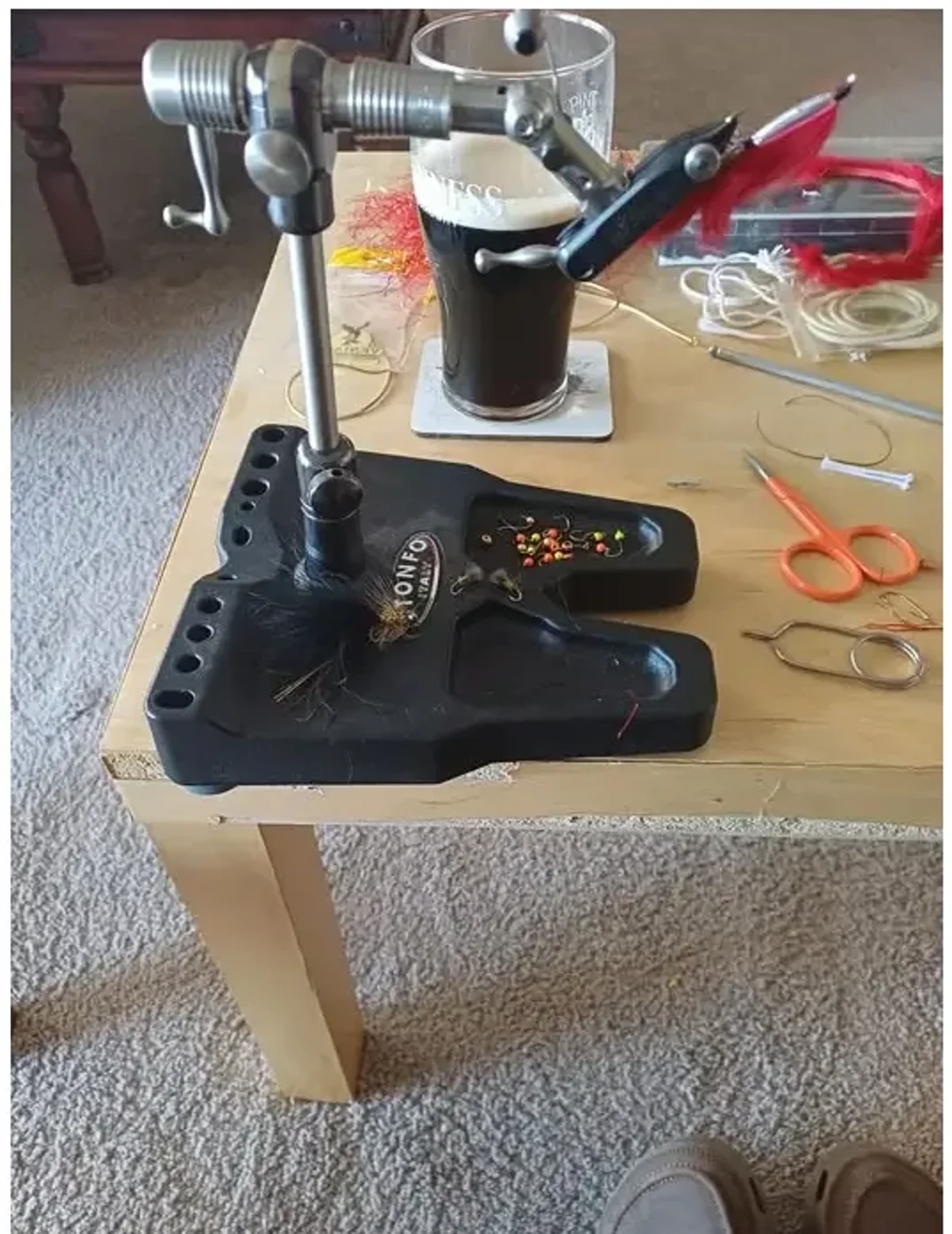
Fly Tying Vices – Pedestal Base or Table Clamp? Which Is Best?
Astute Angling Fly Fishing | Fish Smart. Fish Astute.
Every fly tyer has their own preferences when it comes to tools, materials and techniques. Some like a perfectly organised tying station, while others seem to produce wonderful flies from a workbench that looks as though a small explosion has taken place!
But there's one decision that often gets overlooked when choosing a fly tying vice.
Do you go for a pedestal base or a table clamp?
Both have their advantages, both have their drawbacks, and the right choice often comes down to where, when and how you tie your flies.
The Pedestal Base – Freedom to Move
A pedestal vice sits on a weighted base, allowing it to be positioned almost anywhere on a suitable flat surface.
One of its biggest advantages is flexibility. You're not restricted to the edge of a table, and you can move the vice around until you find a comfortable working position.
For those who enjoy tying flies in front of the television, at the kitchen table or even while away on a fishing holiday, a pedestal base can be particularly convenient.
Advantages of a pedestal base:
-
No need to clamp anything to the table.
-
Easy to move and reposition.
-
Ideal for tables where a clamp cannot be fitted.
-
Convenient for travelling or temporary tying stations.
-
A good option for anyone who prefers the vice positioned further back from the table edge.
However, there are disadvantages.
A pedestal base relies on its weight and grip to remain stable. When applying considerable tension to tying thread, particularly when working on larger flies, a lightweight base may move or even tip.
The weight that provides stability can also make a substantial pedestal less convenient to carry.
The Table Clamp – Firm and Secure
The traditional table clamp has been around for generations, and for good reason.
A clamp secures the vice directly to the edge of a suitable table or workbench, providing a firm and stable working position.
For fly tyers who work with heavier materials, larger hooks or patterns requiring considerable thread tension, this extra stability can be a real advantage.
Advantages of a table clamp:
-
Excellent stability when properly secured.
-
Less chance of movement under thread tension.
-
Generally lighter to transport than a heavy pedestal base.
-
Takes up very little space on the work surface.
-
Particularly useful for a permanent fly tying bench.
But clamps aren't perfect either.
Not every table has an edge suitable for attaching a vice. Thick worktops, decorative edging, drawers and certain modern desk designs can make fitting a clamp difficult or impossible.
There is also the question of protecting furniture. A poorly fitted clamp, particularly one without suitable protective pads, can leave unwanted marks.
And let's face it, that isn't going to go down particularly well if you've borrowed the dining room table!
Does the Type of Fly Make a Difference?
It certainly can.
For someone tying small dry flies, buzzers and nymphs, a good-quality pedestal base may provide all the stability required.
However, when tying larger streamers, salmon flies or heavily dressed patterns, the additional security of a clamp can be useful.
That doesn't mean a pedestal vice cannot handle larger flies. A substantial, well-designed pedestal can be extremely stable.
Equally, a poorly fitted clamp isn't necessarily better than a good pedestal.
The quality of the vice, its mounting system and the surface you're working on are just as important as the choice between base and clamp.
Comfort Matters More Than You Think
One thing that is often overlooked is tying position.
Spending several hours bent over a vice that's too low, too high or too far away can become uncomfortable.
A pedestal base allows you to experiment with different positions on the table, while a clamp generally keeps the vice close to the edge.
Neither arrangement is automatically better ergonomically. Much depends on your chair, table height, vice stem and personal tying style.
If you're going to spend hours at the vice, getting comfortable is worth the effort.
What About the Travelling Fly Tyer?
Many anglers enjoy tying a few flies while away on a fishing trip.
Perhaps you've discovered that the trout are taking something you haven't brought enough of, or maybe you simply enjoy tying a few patterns in the evening.
A compact clamp can be a lightweight solution, provided there's a suitable table available.
A pedestal base offers more flexibility in where you can set up, although the additional weight needs consideration.
For the travelling fly tyer, the ideal solution may be a vice that accepts both mounting systems.
So Which Would I Choose?
There's no universal winner.
If you've got a dedicated fly tying bench and enjoy tying larger patterns, a good table clamp makes a great deal of sense.
If you prefer the freedom to move your vice around, or regularly tie at different locations, a pedestal base may be the better choice.
And if you're fortunate enough to have both options, you've probably got the best of both worlds.
Ultimately, the best fly tying vice is the one that holds your hook securely, allows you to work comfortably and helps you produce the flies you want to fish with.
After all, the trout won't know whether your fly was tied on a £20 clamp or a £100 pedestal!
My Personal Preference – The Pedestal Base
Having used both pedestal bases and table clamps over the years, I have to admit that my personal preference is the pedestal base.
That's not to say there's anything wrong with a clamp. I have both, and each has its advantages, but I find the pedestal arrangement suits the way I like to tie my flies.
For me, it's the freedom to position the vice exactly where I want it. I'm not restricted to the edge of the table, and if I want to move things around a little, I can do so without having to loosen a clamp and start again.
A decent weighted base provides plenty of stability for the majority of flies I tie, from small nymphs and dries through to larger lures.
Of course, that's simply my preference. I know plenty of experienced fly tyers who wouldn't part with their table clamps, and I wouldn't suggest for a moment that they're wrong.
Fly tying is very much about finding what works for you.
If you're just starting out, my advice would be to try both arrangements if you get the opportunity before making your decision.
And if you've been tying flies for years, you'll probably already have a favourite!
The important thing isn't what's holding your vice to the table. It's what's coming off the vice and, hopefully, catching fish!
Over to You – Base or Clamp?
Here's where we'd like to hear from fellow fly tyers.
Are you firmly in the pedestal camp, or have you been using a table clamp for years and wouldn't change?
Perhaps you've tried both and discovered that one suits your style of tying better than the other.
Whatever your preference, we'd love to hear your thoughts.
At Astute Angling, we're always interested in the little things that make our fishing and fly tying more enjoyable.
Fish Smart. Fish Astute.



Thank you for posting your blog comment. It will be reviewed and set live soon. If you provided your email then you will be notified of replies to this comment.